Session 11 Masterclass

The Patagonia Paradox

How does a company that tells you "Don't Buy This Jacket" generate superior economic value? We deconstruct competitive advantage using 2025 Financial Data, Economic Wedges, and the Triple Bottom Line.

Session 11: Shared Value & Competitive Advantage

Learning Objectives

Key competencies for today's session

LO 11-1

Capitalism Models

Compare and contrast shareholder capitalism and stakeholder capitalism while highlighting the strengths and weaknesses of each.

LO 11-2

CSR vs. CSV

Explain the shift in emphasis from corporate social responsibility (CSR) to creating shared value (CSV).

LO 11-3

Accounting Metrics

Appraise accounting metrics and shareholder value creation as measures of competitive advantage.

LO 11-4

Economic Value Linkages

Link economic value creation to different sources of competitive advantage.

LO 11-5

The Balanced Scorecard

Apply a balanced scorecard to assess and evaluate competitive advantage.

LO 11-6

Triple Bottom Line

Apply a triple bottom line to assess and evaluate competitive advantage.

Can a company survive if its primary shareholder is a non-human entity?
00

Case Study: Earth is Now Our Only Shareholder

Patagonia 2025 Impact Report Analysis

In late 2022, Yvon Chouinard transferred ownership of Patagonia (valued at ~$3 billion) to the Holdfast Collective. This move defied traditional shareholder capitalism. Instead of maximizing wealth for a family, all profits not reinvested in the business are now distributed as dividends to protect nature.

Global vs. Indian Context

Global: IKEA is similarly owned by the Stichting Ingka Foundation to prevent takeovers and tax liabilities.

India: The Tata Group operates on a similar "Trust" model. ~66% of Tata Sons is held by philanthropic trusts (Sir Ratan Tata Trust, etc.), ensuring profits fund social good, much like Patagonia's Holdfast Collective.

Estimated Revenue Growth (FY20-FY25)

*Data sourced from 2025 Impact Report & disclosures.

Holdfast Dividends
$180M

Paid to Earth (Sept '22 - Apr '25)

1% for the Planet
$14.7M

Donated in FY2025 alone

Worn Wear (Circular)
Revenue $13M
Repairs 174,799
Who should control the kitchen: the chef, or the person who owns the cash register?
00.2

The Governance Lab

Architecting the "Purpose Trust" Structure

To secure the mission forever, Chouinard split the company into two entities, solving a fatal flaw in capitalism using the "Kitchen vs. Cash Register" framework:

1. The Kitchen

The Purpose Trust
Asset 100% Voting Rights
Power Decide Menu & Hiring
Cost $17.5M Gift Tax

2. The Register

Holdfast Collective
Asset 98% Economic Rights
Function Receive Dividends
Control Zero Votes

The Founder's Fortress

Configure ownership to survive Stress Tests.

SURVIVAL CHANCE: 0%
Voting Power Trust: 50% | Collective: 50%
Economic Rights Trust: 50% | Collective: 50%
Adjust sliders then click a Stress Test to simulate future resilience.
Why does telling customers *not* to buy your product make them want it more?
00.5

The Strategic Paradox

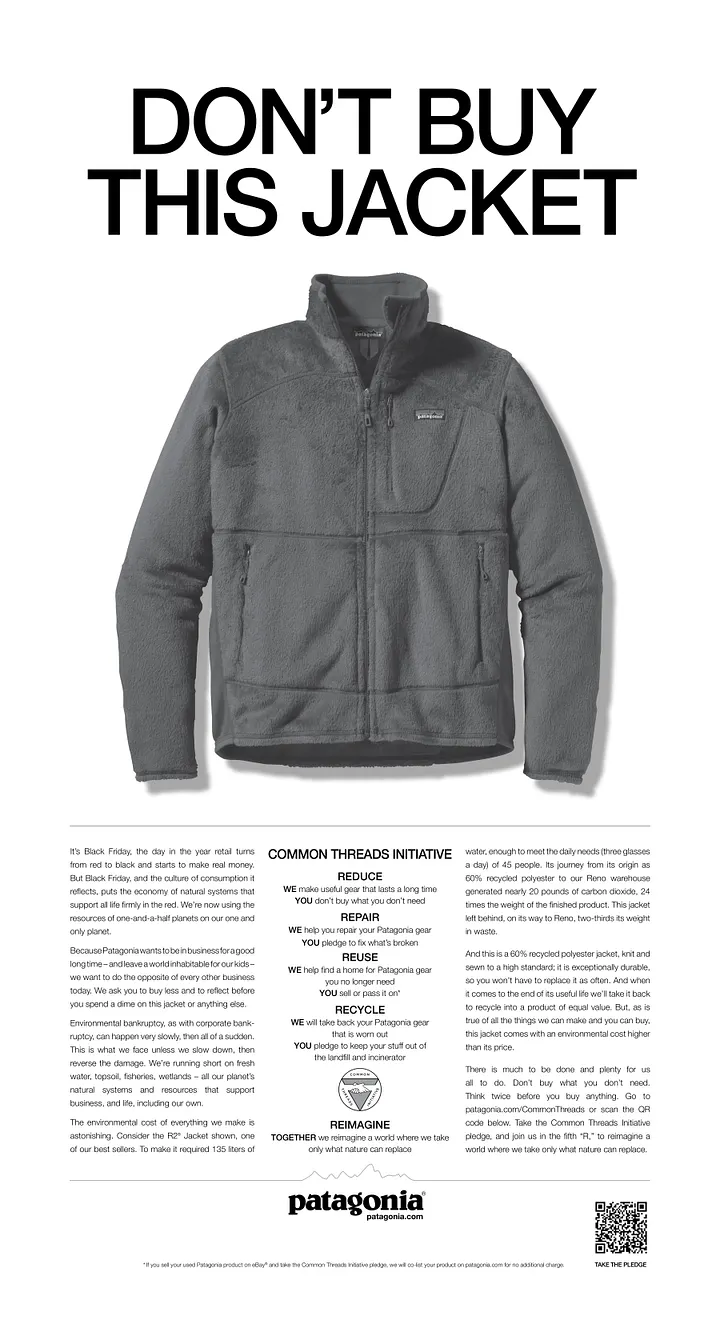
The "Don't Buy This Jacket" Campaign (Black Friday 2011)

Hypothesis Check: If you run this ad on Black Friday, what happens to sales?

1
2
3
Don't Buy This Jacket Full Ad

Signaling Theory & Reverse Psychology

"So back in 6th grade, there was this one girl who was really mad at me because she thought I liked her. Ironically, it was because I was showing just how uninterested I was. I was like, what the heck? Funny enough, that's exactly the case with Patagonia — a company that grew because it didn't want to."

The Beginning

Patagonia started as a climbing equipment company. Their founder, Yvon Chouinard, is an avid climber himself. From the start, Patagonia's aim was to create environmentally friendly, long-lasting, and sustainable clothing. In 1985, they started the "1% for the Planet" campaign, donating 1% of yearly profit to environmental care.

Don't Buy This Jacket

In 2011, they launched a marketing campaign that would change the world forever. It was the "Don't Buy This Jacket" campaign. It was a Black Friday campaign aimed to raise awareness of the fast consumerism happening around the holiday season.

Comparison: Zerodha (India)
Much like Patagonia discourages mindless buying, Indian broker Zerodha actively discourages over-trading. CEO Nithin Kamath frequently blogs about how "Active trading is injurious to wealth." This "Don't Trade" stance builds immense trust, making them the largest broker despite spending $0 on advertising.
The Effects (The Paradox)

Surprisingly, that worked in reverse. Although the campaign's goal was not to sell the item but to raise awareness, a 30% increase in sales was seen after the campaign.

Interactive Insight: Hover over the red hotspots on the image (left) to decode the strategic psychology behind this campaign.
Multi-Level Simulation

The Stewardship Gauntlet

Walk in Chouinard's boots across 4 decades. Every decision pits Profit against Purpose. Can you build a billion-dollar brand without selling your soul?

LEVEL 1: 1994
LEVEL 2: 2011
LEVEL 3: 2022
Social Lab

Collaborative Strategy

Apply the theories of Agency and Shared Value in these group scenarios.

The 1% Council: Strategic Impact Matrix

Multi-Criteria Decision Analysis

Directive: Evaluate options against: Additionality Scalability Irreversibility

Roleplay: The Fiduciary Face-Off

Derivative Lawsuit Threat

Crisis: PE Firm threatens lawsuit, claiming Board is "wastefully" ignoring 3x premium. Click cards to reveal Private Tactics.

The Activist (Principal)

"The 'Earth Tax' breaches fiduciary duty. We demand a liquidity event."

Private Tactic

Quote the Business Judgment Rule. Leverage minority shareholders to force a vote.

The Founder (Steward)

"Brand value is integrity. Strip the mission, and the 3x premium collapses."

Private Tactic

Use the B-Corp Declaration of Interdependence as a legal shield against the lawsuit.

The Employee (Human Capital)

"Our productivity comes from Intrinsic Motivation. You can't buy that."

Private Tactic

Threaten a mass walkout. If talent leaves, the PE firm buys an empty shell.

Discussion: Does Every Company Have a Price?

The "Exit to Community" Debate

If a company uses the Perpetual Purpose Trust model (Steward Ownership), does a "Price" even exist? Or is valuation purely imaginary when sale is legally impossible?

The $100 Billion Question

If a PE firm offered $100 Billion (enough to buy the Amazon rainforest), would refusing be a "betrayal" of the planet, or the ultimate "Shared Value" trade?

Is value defined by the price tag, or the gap between delight and cost?
01

Economic Value Creation

The First Principle: The Value Wedge ($V-C$)

Competitive advantage goes to the firm with the largest gap between Value (V) and Cost (C).

Indian Retail Parallel:
Consider Fabindia vs. Zudio (Tata).
  • Fabindia: High Cost (artisanal), High Value (heritage). Creates value through differentiation.
  • Zudio: Low Cost (efficient scale), Medium Value (fast fashion). Creates value through cost leadership.

Simulation: The Value Wedge

INTERACTIVE LAB

Economic Value Created

$120

Profit is an opinion. Cash is a fact. Do you know the difference?
02

Accounting Profitability

The Solvency Check

Mission requires margin. We use Liquidity Ratios (extracted from your text) to ensure Patagonia can pay its fair-trade suppliers on time.

Warning from the Startup World:
Consider Byju's (India). High valuation (accounting opinion) masked severe liquidity crunches (cash fact). Patagonia maintains high liquidity to avoid dependency on banks or VCs.

CFO Dashboard: Solvency Test

Balance Sheet ($M)

Current Ratio -- Benchmark: > 1.5
Quick Ratio -- Benchmark: > 1.0
If your factory burns down, you rebuild. If your reputation burns down, what happens?
03

Intangibles & Valuation

The Invisible Balance Sheet

Intangible assets (Brand, IP, Culture) now dominate market value.

Indian Example: Asian Paints
Asian Paints trades at a massive premium not because of its paint (tangible), but because of its Supply Chain Efficiency (intangible).

Simulation: The Multiplier Effect

Book Value $10B
Market Value $50B

Strong brands multiply the value of tangible assets.

Exhibit 11.3: The Rise of Intangibles

Who owns the future—the one who trades the stock today, or the one who builds the product for tomorrow?
04

Shareholder Value Creation

Risk Capital, Market Cap & The Tale of Two Tech Giants

Shareholders are the legal owners of public companies. They provide Risk Capital, which cannot be recovered if the firm goes bankrupt.

Market Capitalization

Market Cap = Outstanding Shares × Share Price

Exhibit 11.4 Analysis: Apple vs. Microsoft

  • Microsoft (1999): Peak of the Dot-com boom at ~$600B.
  • The Lost Decade (2000-2010): Microsoft stagnated as it struggled to transition from desktop to mobile/cloud.
  • Apple's Ascent (2007-2020): The iPhone (2007) supercharged valuation. In 2020, Apple became the first company to reach a $3 Trillion market cap.
  • The Nadella Turnaround (2014): Appointed CEO in 2014, Satya Nadella shifted Microsoft to "Mobile First, Cloud First." This pivotal strategy drove Microsoft to overtake Apple briefly in 2020, reaching ~$2.2T by 2022.

Exhibit 11.4: Market Valuations ($ Trillions)

Apple vs. Microsoft (1995-2022). Note the "Lost Decade" vs. the "Cloud Renaissance".

Simulation: The Nadella Pivot

Strategic Leadership in 2014

STRATEGY LAB

Scenario: It is 2014. You are Satya Nadella. Microsoft is a "Windows Company," making billions from OS licenses. But the world is moving to Mobile (where you failed) and Cloud (where Amazon leads).

What is your core strategy?

Awaiting Decision...

Group Activity: Valuation Forensics

Analyze the graph above. Identify the crossover point around 2010. Discuss in groups:

Question 1

Why did Apple's value skyrocket starting in 2007, even during the 2008 financial crisis?

Question 2

Microsoft was flat for 10 years. What cultural trap were they likely stuck in before 2014?

Shareholder Capitalism in Crisis?

Since the millennium, the implicit trust between corporations and society has fractured. A series of "Black Swan" events has led to critical scrutiny of value creation:

  • Trust Erosion (Enron, WorldCom): Accounting scandals destroyed billions in retirement savings, shattering public faith.
  • Systemic Failure (2008 Crisis): The financial system nearly collapsed due to subprime greed, leading to a deep global recession and the Occupy Wall Street movement.
  • Social Unrest (George Floyd, Brexit): Growing inequality and a sense that the "economy isn't working for all" have fueled massive social and political upheavals.
  • Pharma Ethics (Purdue & Turing): The opioid crisis (Purdue) and price-gouging (Martin Shkreli) highlighted the moral bankruptcy of pure profit maximization.

The Friedman Doctrine (1970)

"There is one and only one social responsibility of business—to use its resources and engage in activities designed to increase its profits." — Milton Friedman

Efficiency: The price system coordinates millions without a central planner.
Freedom: Corporations have rights and freedom is primary.
Agency: Managers are agents of owners, not social workers.

Strategic Trade-off

The Scale Paradox

Growing a private business is hard. IPOs provide capital but demand quarterly conformity.

Nike (Public) Massive Scale. Small ESG changes have huge absolute impact.
Patagonia (Private) Purity. Privacy avoids short-term pressure, allowing radical acts.

Simulation: The Ethics Engine

The Martin Shkreli / Turing Pharma Case

CRISIS MODE

Scenario: You are the CEO of Turing Pharma. You acquired rights to Daraprim, a life-saving drug for AIDS patients.
Cost to Produce: $1/pill.
Current Price: $13.50/pill.
Market Condition: No competitors for 5 years. FDA approval pending for rivals.

Simulation: The CEO's Dilemma

Based on the Howard Schultz (Starbucks) Case Study.

LIVE DECISION

Scenario: You are the CEO. You have $1 Billion in net profits.
Shareholder View: Profits belong to owners. Buying back stock raises share price immediately.
Stakeholder View: Profits should be reinvested in employees and customer experience.

How do you allocate the capital?

Awaiting Decision...
Is "doing good" a cost of doing business, or a profit center?
04.5

CSR vs. Creating Shared Value (CSV)

The Larry Fink Effect & The Evolution of Purpose

The Shift: Corporate Social Responsibility (CSR) is often reactive—philanthropy and "good citizenship" added after profits are made. Creating Shared Value (CSV) is proactive—baking societal value into the core strategy to generate profit.

The BlackRock Factor

Larry Fink (CEO of BlackRock, $10T AUM) fundamentally changed the game. By forcing companies like ExxonMobil to disclose emissions and pivot to renewables, he argued that ESG is not politics, it is capitalism. Ignoring climate risk is an investment risk.

Exhibit 11.2: CSR vs. CSV

Focus Shift →
Philanthropy Joint Value Creation
Action Shift →
Reactive (PR) Proactive (Strategy)
Example Shift →
Fair Trade Purchasing Transforming Supply Chain
Simulation

The Boardroom Coup

Based on ExxonMobil vs. Engine No. 1 (2021)

LIVE SCENARIO

Scenario: You are the CEO of a massive Fossil Fuel giant. A tiny activist hedge fund (owning just 0.02% of shares) has nominated 3 renewable energy experts to replace your loyal board members.

BlackRock's Stance: Larry Fink holds 6% of your stock. He demands a net-zero plan.

How do you respond?

Awaiting Strategy...

Activity: The Classification Game

Classify these real-world initiatives. Are they CSR (Good Citizen) or CSV (Core Strategy)?

Roleplay: The ESG Showdown

Setting: The Annual General Meeting (AGM).
Topic: Should we sell our coal division?

Role A: The BlackRock Proxy "We manage pension money. If you hold onto coal, you will be bankrupt in 10 years. We vote to sell."
Role B: The Traditional CEO "Coal generates the cash flow that funds our dividends. We cannot abandon our core competency."
Role C: The Gen-Z Employee "If we don't sell, I quit. And so does the top engineering talent you need."
05

The Balanced Scorecard

Aligning Mission with Metrics

Interactive Challenge: The KPI Matcher

A "Balanced" Scorecard tracks 4 perspectives. Can you match the right metric to the Learning & Growth perspective?

Customer

"How do customers view us?"

Metric: Ironclad Guarantee Returns < 2%

Internal

"How do we create value?"

Metric: 100% Traceable Down Supply Chain

Learning

"What competencies do we need?"

Metric: Employee Retention > 95%

Financial

"How do shareholders view us?"

Metric: 1% of Sales to Earth (Earth Tax)
06

Circular Business Models

From Linear to Circular (Worn Wear)

Linear Model: Make → Use → Waste. Requires constant new resources.

Circular Model: Make → Use → Repair → Resell.

Insight: Reselling a used jacket has Zero Production Cost ($C), creating a pure margin contribution.